Finished fabric buyer guide
What Is Rib Knit Fabric? A Buyer Guide
Rib knit fabric uses alternating knit and purl columns to form visible vertical ribs and useful crosswise extension. The family includes fine 1x1 ribs, wider 2x2 ribs, compact trim ribs, and fashion ribs used as body fabric. Stretch and recovery are not fixed by the name, so buyers must approve the exact gauge, composition, weight, width, finish, and garment behavior.
Updated 2026-07-17 · Reviewed by O'range Textile Finished Fabric Team
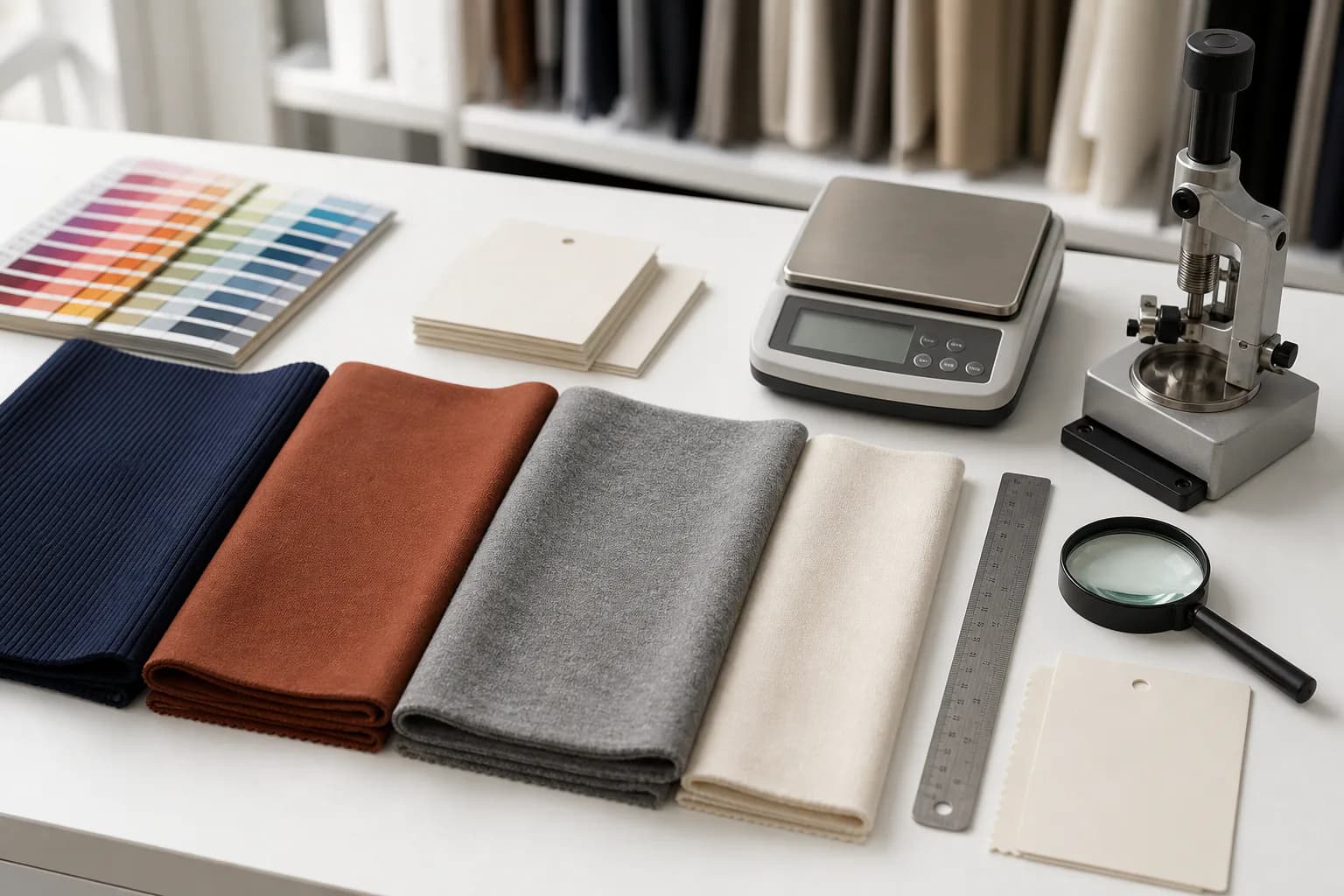
Rib structure creates columns and crosswise extension
Alternating knit and purl wales create the characteristic ridged surface. The structure can draw inward and extend across the width, making rib useful where a garment needs close fit, recovery or a visible linear texture.
Rib repeat, machine gauge, yarn, elastane, density and finishing change the outcome. A fine body rib for a dress and a compact collar rib for a sweatshirt may share a family name while behaving very differently in width, recovery, weight and seam bulk.
Body rib and trim rib require different approval logic
Trim rib must coordinate with a body fabric and recover after extension at collars, cuffs or waistbands. Body rib must also satisfy opacity, drape, growth, comfort and dimensional requirements across larger garment panels.
Do not approve trim from a loose strip alone. Attach it to the body fabric using the planned seam and ratio. For body rib, use a full panel or garment because widthwise draw-in and growth affect pattern consumption and fit.
| Use | Primary decision | Sample method |
|---|---|---|
| Collar | Recovery and neckline shape | Sew to actual body fabric |
| Cuff | Extension and return | Repeat wear simulation |
| Waistband | Support and seam bulk | Test at garment circumference |
| Body garment | Opacity, growth and drape | Cut representative panel |
Rib spans trims, fitted apparel and fashion texture
Rib is used in collars, cuffs, neckbands, waistbands, tanks, fitted tops, dresses, skirts, loungewear, base layers and contrast panels.
A visible wide rib can become the design, while a fine rib can read as a smooth fitted surface. The buyer should state rib repeat and visual scale rather than leave the supplier to interpret a reference photo.
- Collars, cuffs and neckbands
- Waistbands and fitted hems
- Tanks and fitted tops
- Dresses, skirts and base layers
- Texture panels and coordinated trims
Specify rib repeat, gauge and recovery
Record rib repeat, gauge if relevant, composition, GSM, usable width, tubular or open presentation, stretch direction, extension, recovery, color, finish and application. Do not collapse these fields into a single adjective such as premium, soft, heavy, or stretchy. The supplier and buyer need the same written target and the same labeled physical reference.
If the rib must match a body fabric, include the body article, color standard and sewing ratio in the development brief. If a requirement is not yet known, mark it as a proposal field instead of leaving it implicit. That allows the supplier to explain the trade-off and prevents an exploratory sample from being mistaken for final approval.
| Specification field | Why it matters | Approval evidence |
|---|---|---|
| Construction | Defines 1x1, 2x2, wide rib, compact trim or other rib structure | Labeled sample and article sheet |
| Composition | Defines fibre identity, not complete behavior | Written supplier declaration and buyer-required verification |
| GSM and usable width | Affects body, consumption and pattern planning | Agreed method and approved specification |
| Surface and finish | Controls rib scale, face, reverse, luster and finish | Face/reverse review and approved swatch |
| Performance | Focuses on extension, recovery, growth, torque, seam and care | Garment trial and applicable test plan |
Test extension at the garment's real working range
Inspect rib repeat, surface, edges and several positions. Measure width consistently because rib can draw in and relax differently depending on handling and condition.
Extend the fabric only to the range expected in the garment and observe recovery after an agreed interval. Excessive test extension can create misleading failure that the garment would never experience.
- 01Label the submission with supplier, article, color, date and version.
- 02Inspect rib repeat, gauge, face, reverse, width, GSM, extension, recovery, growth, torque and surface.
- 03Record measurements and visible observations against the brief.
- 04Run body-fabric attachment, garment extension, seam, wash and dimensional checks on the exact submitted article.
- 05Approve one dated sample and list unresolved tests or commercial terms.
Connect the learning page to a finished-fabric RFQ
O'range Textile's supplied catalogue describes 104 finished-fabric records across 11 series. The parent company's supplied machine record describes 200+ circular knitting machines across double-knit and rib configurations, including 40+ rib/72-feed machines across multiple configurations. These records provide context for development review, but they do not replace article-specific data.
Send the intended garment, construction, composition, target GSM, usable width, color, finish, quantity, destination, sample deadline and testing requirements. State whether rib is trim or body fabric and identify the fabric it must coordinate with. Confirm availability, MOQ, lead time, packing, testing, payment and shipping through the current quotation.
- Name the garment and panel where the fabric will be used.
- Separate fixed requirements from supplier proposal fields.
- Request a labeled finished-fabric sample and matching data sheet.
- State buyer, market and destination requirements before quotation.
- Link final approval to one sample version and written specification.
Evidence boundary
The supplied catalogue supports a finished-fabric range and documents 104 product records across multiple series. Construction names, composition, GSM, usable width, finish, color, testing status, lead time, and commercial terms still have to be confirmed for the exact offered article and order.
Buyer questions
Frequently asked questions
What is the difference between 1x1 and 2x2 rib?
The terms describe arrangements of knit and purl columns. They create different visual scales, draw-in, thickness and recovery, which must be checked on the actual article.
Is rib knit only used for cuffs?
No. Rib is used for trims and also for tanks, fitted tops, dresses, skirts, base layers, loungewear and fashion panels.
Does rib knit need spandex?
Not always. Rib structure can stretch without elastane, while elastane may be added for particular extension and recovery. Confirm composition and performance.
Why does rib fabric look narrower when relaxed?
Rib structures can draw inward because of their loop arrangement. Handling, condition, density and fibre also affect relaxed width.
How should trim rib be approved?
Sew it to the actual body fabric at the planned ratio, then check appearance, recovery, seam bulk, color match and care response.
Move from category research to a sample brief
Share the garment use, construction direction, composition, target GSM, usable width, color, finish and tests that matter. The team can then confirm the appropriate article and quotation route.