Finished fabric knowledge base
Knit Fabric Buyer Guides for Sourcing Teams
This library gives sourcing teams an answer-first route from fabric terminology to a measurable sample decision. Each guide defines one finished-knit category, explains where it differs from adjacent structures, lists the fields that belong in a specification, and links to the relevant product and inquiry route. Use the articles to prepare questions, not to replace a labeled sample or current quotation.
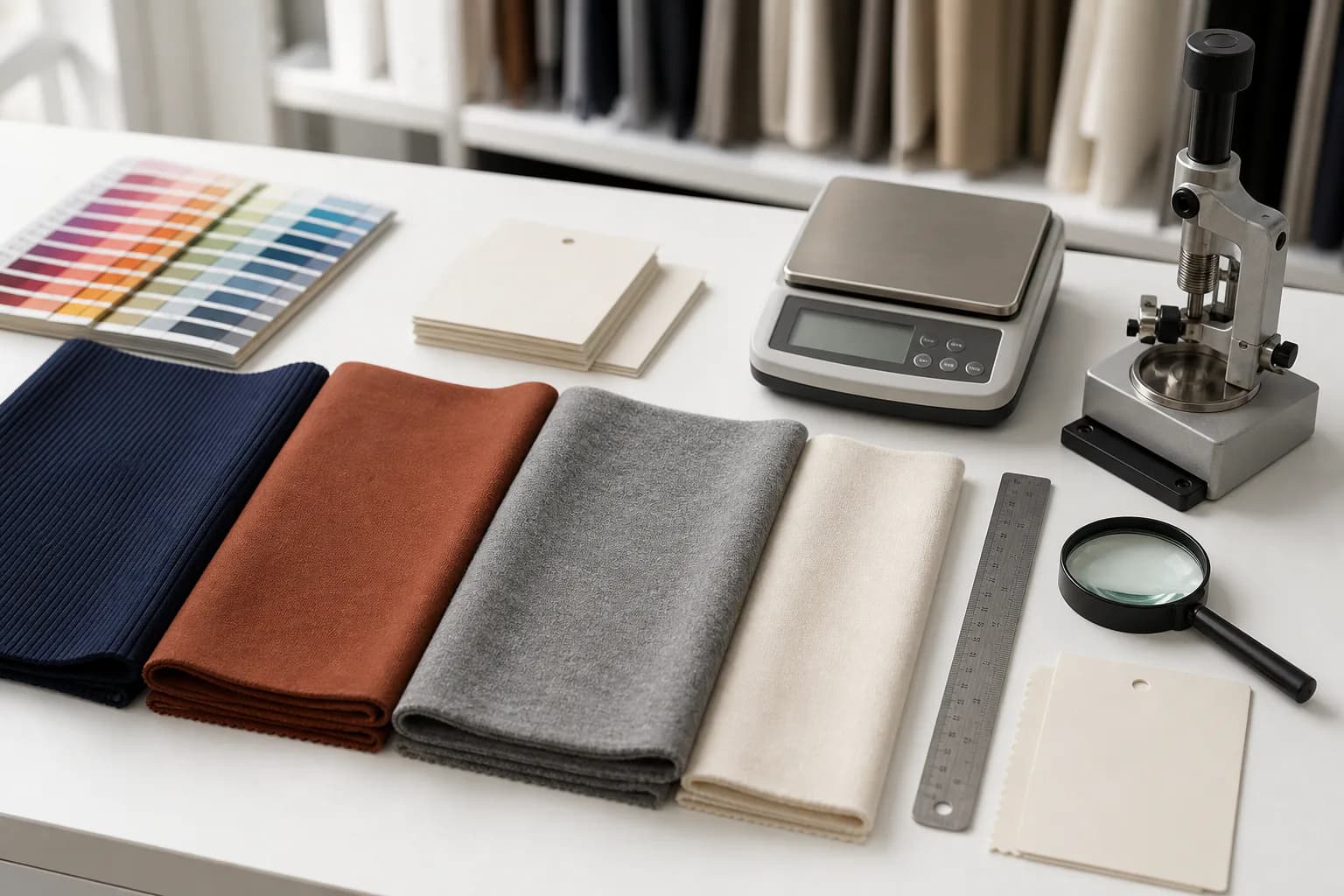
Finished-fabric buyer guides
Choose a construction question to investigate
Each guide connects a buyer question to specification checks, sample evidence, and a relevant finished-fabric sourcing route.
What Is Double Knit Fabric? A Buyer Guide
What is double knit fabric, and how should an apparel buyer evaluate it? Learn how two needle systems create a stable knit family, compare common constructions and uses, then review composition, GSM, width, stretch, recovery and the finished sample before sourcing.
What Is Interlock Fabric? A Buyer Guide
What is interlock fabric, and when does it suit an apparel program? Understand its double-knit construction, smooth faces, stability and typical uses, then compare composition, GSM, width, stretch, recovery and sample performance before choosing a supplier route.
What Is Ponte Fabric? A Buyer Guide
What is Ponte fabric, and why is it used for structured knitwear? Review Ponte Roma body, drape, stretch, recovery and garment applications, then compare composition, GSM, usable width, surface and finished-sample behaviour before sourcing.
What Is Scuba Knit Fabric? A Buyer Guide
What is scuba knit fabric, and how does it differ from neoprene or air-layer naming? Review structure, thickness, compression, recovery and apparel uses, then confirm the exact construction, composition, GSM, width and finished-sample behaviour.
What Is Rib Knit Fabric? A Buyer Guide
What is rib knit fabric, and why does its alternating knit-and-purl geometry affect stretch and recovery? Review common apparel and trim uses, then compare rib ratio, composition, GSM, usable width, colour matching and finished-sample performance.
Jacquard Knit vs Woven Jacquard for Apparel Buyers
Jacquard knit vs woven jacquard compares two pattern-forming routes with different stretch, structure, edge behaviour and apparel uses. Learn what buyers should inspect on the face and reverse, then confirm composition, weight, width, motif scale and finish.
Air Layer Knit Fabric Sourcing Guide for Apparel Buyers
Air layer knit fabric sourcing guide for comparing documented articles such as GD2515 and GD2672, with practical checks for composition, 260–300 GSM directions, usable width, structure, recovery, seams, sample approval, and commercial confirmation.
How to Source Wool Blend Knit Fabric with Verifiable Evidence
How to source wool blend knit fabric using article-level composition evidence, hand and surface review, GSM, usable width, brushing, pilling, colourfastness, care, garment testing, sample approval, and commercial confirmation before production.
Jacquard Knit Fabric Weight and Width for RFQ Planning
Jacquard knit fabric weight and width guide using article GD2579 at 240 GSM and GD2683 at 280 GSM with 160–165 cm references, plus repeat, reverse, finish, usable width, cutting yield, sample approval, and commercial confirmation.
Brushed Knit Fabric Finishes and Raised-Pile Sourcing Checks
Brushed knit fabric finishes guide for comparing faux-cashmere, acetate-brushed, and raised-pile directions, with buyer checks for face and reverse, shedding, pilling, GSM, usable width, colour, care, sample approval, and commercial confirmation.
Knit Fabric RFQ Template for a Complete Sourcing Brief
Knit fabric RFQ template for apparel buyers who need to state construction, article reference, composition, GSM, usable width, colour, finish, testing, quantity, destination, sample approval, packing, documentation, and commercial confirmation.
Knit Fabric Sourcing Questions for Faster Buyer Decisions
Knit fabric sourcing questions answered for apparel buyers comparing construction, composition, GSM, usable width, finish, article evidence, testing, sample approval, live availability, order details, documentation, and commercial confirmation.
French Terry Fabric vs Fleece for Apparel Buyers
French terry fabric vs fleece compares loop-back and brushed sweatshirt fabrics for hoodies, sweatshirts and loungewear. Review warmth, drape, shedding, GSM, shrinkage, care and sample evidence before choosing a finished fabric and requesting a quotation.
French Terry Fabric for Hoodies: Sourcing Decisions
French terry fabric for hoodies should be selected by loop structure, face, GSM, usable width, shrinkage, stretch, recovery and care route. Use this buyer guide to define the garment brief, inspect a finished sample and request current commercial confirmation.
Heavyweight French Terry Fabric for Hoodie Programs
Heavyweight French terry fabric adds mass and body, but GSM alone does not prove warmth, softness or durability. Compare loop structure, density, usable width, shrinkage, seams, brushing and care on a labelled finished sample before approving a hoodie program.
Interlock vs Jersey Fabric for Apparel Sourcing
Interlock vs jersey fabric compares a stable double-knit construction with a lighter single-knit direction. Review face and reverse, edge curl, opacity, drape, stretch, recovery, GSM, shrinkage and garment use before selecting a finished sample.
Start with the construction question
Choose a definition guide when the buyer is deciding what a fabric name actually means. The direct answer appears first, followed by structural distinctions, applications, specification fields, sample checks and a route to finished-fabric development.
This organization supports human readers and AI answer systems without repeating the same generic article. Every page has a different decision purpose and an evidence boundary.
- What Is Double Knit Fabric?
- What Is Interlock Fabric?
- What Is Ponte Fabric?
- What Is Scuba Knit Fabric?
- What Is Rib Knit Fabric?
- Jacquard Knit vs Woven Jacquard
Move from definition to product route
The double-knit guide connects to the category hub. Interlock, Ponte, scuba, rib and jacquard guides connect to dedicated product pages. Those pages add manufacturing fit, documented catalogue evidence, buyer applications, sample process and RFQ fields.
Internal links are part of the sourcing workflow rather than decorative SEO. A reader can move between the broad category, precise product, comparison guide and contact action without returning to a search engine.
| Question | Product route | Action |
|---|---|---|
| What is double knit? | Finished double knit hub | Choose subtype |
| What is interlock? | Interlock development | Confirm construction |
| What is Ponte? | Ponte Roma fabric | Test body and recovery |
| What is scuba knit? | Air-layer fabric | Verify structure |
| What is rib knit? | Rib knit fabric | Set repeat and function |
| Jacquard knit vs woven | Jacquard knit fabric | Review repeat and reverse |
Use the same evidence discipline in every article
The guides do not invent certifications, universal MOQ, fixed lead time or unverified performance claims. They separate general textile knowledge, company-level manufacturing evidence, catalogue-level ranges, and article-level facts that require confirmation.
For publication, each article includes unique metadata, a direct opening answer, at least four dedicated H2 sections, a comparison or diagnostic table, FAQ answers, internal routes, Article and FAQ schema, descriptive imagery and a visible sourcing boundary.
- General definition and decision logic
- Construction-specific comparison
- Application and specification checklist
- Finished sample and garment trial
- Product, hub and inquiry internal links
Prepare the sample request before you contact the supplier
Write down the garment, panel function, fixed construction or acceptable alternatives, target composition, GSM, usable width, surface, finish, color, quantity, destination and deadline. Add required testing or documentation instead of asking whether the fabric is simply good quality.
When a field is open, label it as a proposal. The supplier can then recommend an article and explain why it fits. Keep every sample version labeled so the approved result can be traced into quotation and production.
- 01Read the relevant definition or comparison guide.
- 02Open the product route and review manufacturing fit.
- 03Write fixed requirements and proposal fields.
- 04Request labeled samples with matching article data.
- 05Approve one version and confirm the commercial quotation.
Evidence boundary
The supplied catalogue supports a finished-fabric range and documents 104 product records across multiple series. Construction names, composition, GSM, usable width, finish, color, testing status, lead time, and commercial terms still have to be confirmed for the exact offered article and order.
Buyer questions
Frequently asked questions
Are these articles ready to use as fabric specifications?
No. They help a buyer prepare a specification. The exact article, values, methods and acceptance criteria belong in the approved sample and written order documents.
Why do the guides link to product pages?
The links connect an informational question to a relevant finished-fabric development route and then to a sample or RFQ action.
Do the guides make certification claims?
No. Testing and certification are treated as order-specific requirements that must be supported by applicable evidence.
Move from category research to a sample brief
Share the garment use, construction direction, composition, target GSM, usable width, color, finish and tests that matter. The team can then confirm the appropriate article and quotation route.