Finished fabric buyer guide
What Is Interlock Fabric? A Buyer Guide
Interlock fabric is a double-knit construction formed by intermeshing rib systems, commonly creating two smooth-looking faces, useful body, and more edge stability than typical single jersey. It can suit tops, dresses, childrenswear, uniforms, linings, and soft structured pieces. Buyers must confirm true interlock construction, composition, GSM, usable width, finish, stretch, recovery, and garment performance on the offered sample.
Updated 2026-10-23 · Reviewed by O'range Textile Finished Fabric Team
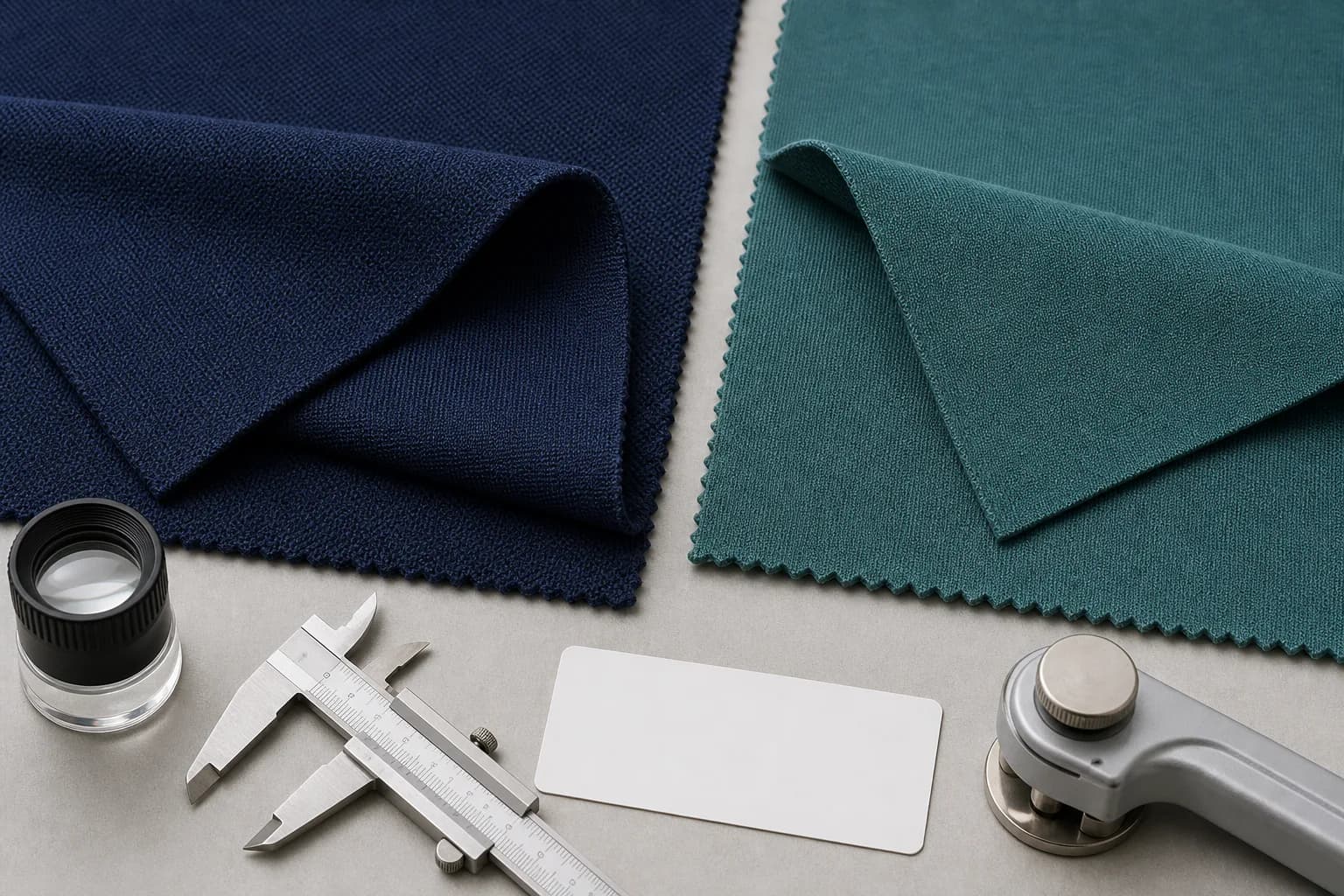
How interlock construction creates balanced surfaces
Interlock forms connected loops in a way that can produce similar-looking face and reverse sides. Compared with many single jerseys, it often feels fuller, lies flatter at a cut edge, and provides a cleaner base for selected garments or decoration routes.
The exact result changes with yarn count, gauge, loop length, fibre, elastane, density, dyeing and finishing. A smooth double-sided sample may also be another double-knit structure, so a supplier should name the construction on the article sheet rather than rely only on visual description.
Interlock, single jersey and Ponte are not interchangeable
Single jersey often provides lighter drape and visibly different faces. Interlock commonly provides smooth balanced faces and moderate body. Ponte Roma typically provides more compact structure and tailoring body, although commercial naming can blur these boundaries.
Choose by garment behavior. A light tee may call for jersey, a polished soft layer may call for interlock, and fitted tailoring may call for Ponte. If two constructions appear plausible, request both and run the same pattern and care checks.
| Field | Interlock | Buyer implication |
|---|---|---|
| Faces | Often smooth and similar | Confirm face designation and finish |
| Body | Moderate and balanced | Check drape and seam profile |
| Edges | Often relatively stable | Still test cutting and sewing |
| Stretch | Varies by article | Do not assume elastane or recovery |
Use interlock where surface and stability matter
Interlock can be a useful starting point for dresses, polished tops, childrenswear, uniforms, soft jackets, base layers, stable linings, and selected sport or lounge pieces.
For print or embroidery, confirm the finish and actual decoration route. For fitted garments, confirm recovery. For childrenswear or uniforms, add the buyer's care and market requirements to the brief.
- Clean-surface tops and dresses
- Uniform and schoolwear directions
- Soft jackets and layers
- Childrenswear and base layers
- Stable printable or decorative panels
Write an interlock brief that prevents substitution
Name true interlock as the requested construction and define whether adjacent smooth double knits may be proposed as alternatives. Do not collapse these fields into a single adjective such as premium, soft, heavy, or stretchy. The supplier and buyer need the same written target and the same labeled physical reference.
Record face, reverse, GSM, width, stretch direction, recovery, opacity, color, finish and intended decoration so a visual look-alike does not replace the approved behavior. If a requirement is not yet known, mark it as a proposal field instead of leaving it implicit. That allows the supplier to explain the trade-off and prevents an exploratory sample from being mistaken for final approval.
| Specification field | Why it matters | Approval evidence |
|---|---|---|
| Construction | Confirms true interlock rather than a generic smooth double knit | Labeled sample and article sheet |
| Composition | Defines fibre identity, not complete behavior | Written supplier declaration and buyer-required verification |
| GSM and usable width | Affects body, consumption and pattern planning | Agreed method and approved specification |
| Surface and finish | Defines smoothness, luster, print base, opacity and face designation | Face/reverse review and approved swatch |
| Performance | Controls recovery, growth, edge, seam and care response | Garment trial and applicable test plan |
Check both faces, recovery and seam response
Inspect both faces in consistent light and compare several areas. Look for barre, needle lines, inconsistent loops, contamination, surface marks, holes or unexpected directional effects.
Measure the fields relevant to the brief and sew the intended seam. A stable loose swatch can still show seam waving, growth, pressing marks or recovery issues in garment development.
- 01Label the submission with supplier, article, color, date and version.
- 02Inspect both faces, loop balance, edge curl, weight, width, opacity, extension, recovery and surface consistency.
- 03Record measurements and visible observations against the brief.
- 04Run seam, print or decoration, fit, laundering and dimensional checks selected by the buyer on the exact submitted article.
- 05Approve one dated sample and list unresolved tests or commercial terms.
Connect the learning page to a finished-fabric RFQ
O'range Textile's supplied catalogue describes 104 finished-fabric records across 11 series. The parent company's supplied machine record describes 200+ circular knitting machines across double-knit and rib configurations. The parent record documents double-knit machine groups, while exact interlock construction remains article-specific. These records provide context for development review, but they do not replace article-specific data.
Send the intended garment, construction, composition, target GSM, usable width, color, finish, quantity, destination, sample deadline and testing requirements. Ask the quotation to identify construction and any proposed substitute clearly. Confirm availability, MOQ, lead time, packing, testing, payment and shipping through the current quotation.
- Name the garment and panel where the fabric will be used.
- Separate fixed requirements from supplier proposal fields.
- Request a labeled finished-fabric sample and matching data sheet.
- State buyer, market and destination requirements before quotation.
- Link final approval to one sample version and written specification.
Evidence boundary
The supplied catalogue supports a finished-fabric range and documents 104 product records across multiple series. Construction names, composition, GSM, usable width, finish, color, testing status, lead time, and commercial terms still have to be confirmed for the exact offered article and order.
Buyer questions
Frequently asked questions
Is interlock fabric thicker than jersey?
Interlock is often fuller than comparable single jersey, but GSM and thickness vary. Compare actual conditioned samples and written specifications.
Does interlock fabric have two right sides?
Its faces commonly look similar, but the supplier may still designate a face based on finish, appearance or processing. Confirm the production face.
Is interlock suitable for T-shirts?
It can suit heavier, smoother or more structured tops. A lightweight classic tee may favor single jersey. The pattern, climate, opacity and hand determine the choice.
Can interlock fabric include spandex?
Yes, some articles include elastane, while others do not. Confirm exact composition and recovery rather than infer it from the construction.
How do buyers confirm true interlock?
Request the named construction on the article sheet, inspect both faces and loop behavior, and retain the labeled approved sample with the final specification.
What does interlock mean on a T-shirt label?
It means the shirt is knitted as interlock rather than single jersey: a double knit with smooth faces on both sides, more body and less edge curl. The word describes construction, not fibre, so check the composition line for cotton, polyester, modal or elastane.
What is interlock fabric made of?
Interlock names the knit construction, not the material. It is commonly knitted from cotton, polyester, modal, viscose or blends, sometimes with elastane. Fibre, yarn count, GSM and finishing decide the hand feel, weight and performance of a specific article.
Is interlock warmer than jersey?
With a similar fibre and yarn, interlock is usually fuller and denser than single jersey, so it tends to feel warmer and more opaque. GSM, fibre and brushing matter more than the construction name, so compare the actual samples side by side.
Move from category research to a sample brief
Share the garment use, construction direction, composition, target GSM, usable width, color, finish and tests that matter. The team can then confirm the appropriate article and quotation route.