Jacquard specification guide
Jacquard Knit Fabric Weight and Width for RFQ Planning
Jacquard knit fabric weight and width should be read with construction, repeat, face and reverse, stretch, finish and intended garment placement. GSM and usable width guide body and consumption, but the approved sample determines whether the pattern and performance fit the program.
Updated 2026-07-28 · Reviewed by O'range Textile sourcing team
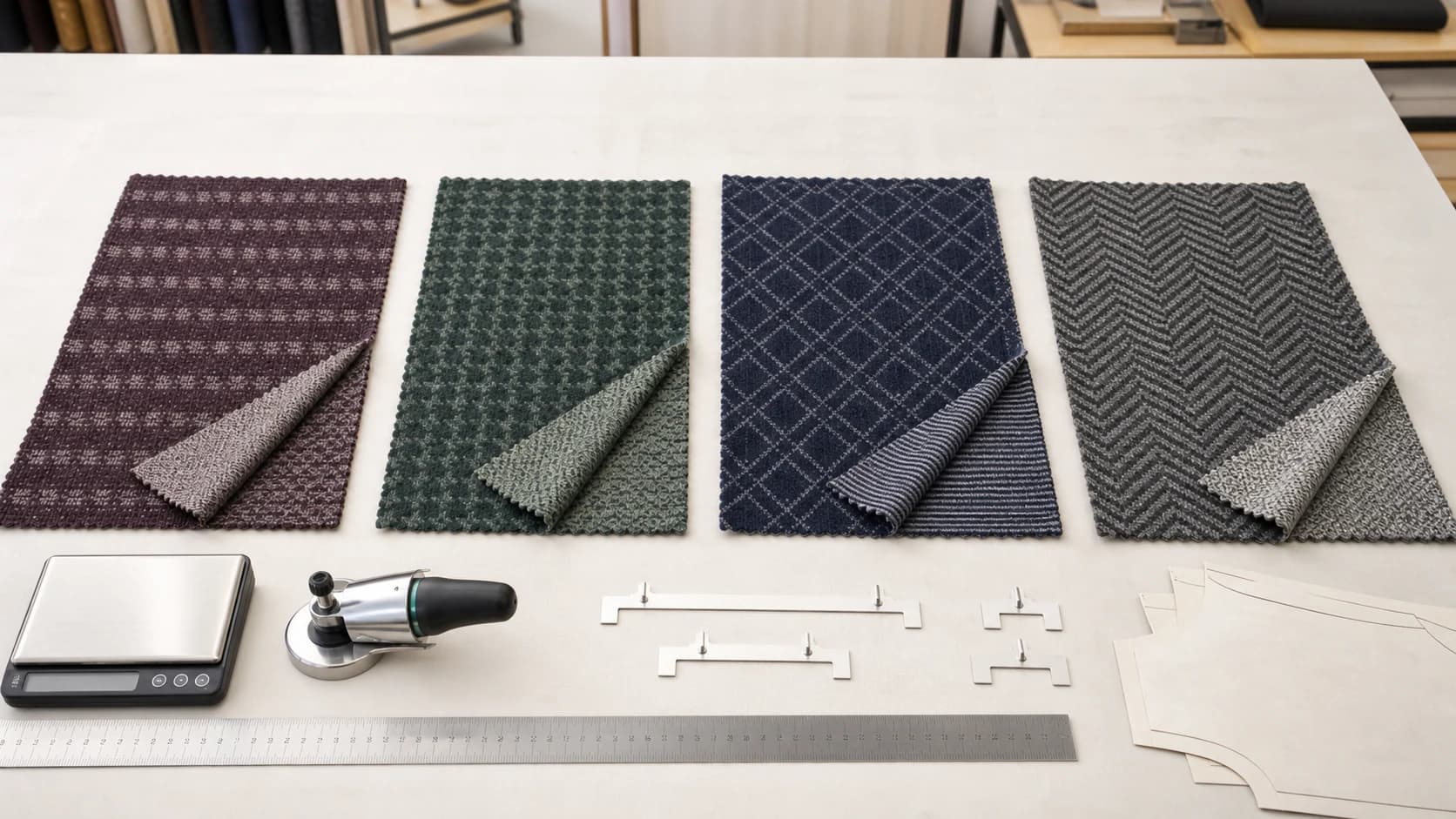
Use GSM to describe body, not quality
GSM records fabric mass per square metre. It helps buyers compare body and consumption, but it does not prove durability, warmth, softness or suitability by itself. Two jacquards at similar GSM can differ because of yarn, structure, repeat, density, finish and reverse floats.
The catalogue records GD2579 at 240 GSM and GD2683 at 280 GSM. Both are wool-blend jacquard directions with 160-165 cm width references, yet they should be reviewed as separate articles. Compare body, drape, pattern clarity, reverse, stretch and garment response on labeled samples.
| Article | GSM and width reference | Buyer check |
|---|---|---|
| GD2579 | 240 GSM; 160-165 cm | Lighter body, repeat scale, reverse and cutting yield |
| GD2683 | 280 GSM; 160-165 cm | Higher body, seam bulk, drape and pattern placement |
| GD2583 | 240 GSM; 160-165 cm | Confirm colour, motif, face/reverse and current article data |
Use usable width for marker and repeat planning
Usable width is the cuttable area available for pattern planning. A jacquard buyer also needs repeat dimensions and the orientation of the motif. The nominal roll width is not enough when edges, distortion, motif placement or shade zones reduce usable area.
Request enough material to see at least one complete repeat across the relevant direction. Place real garment pieces on the sample and estimate matching waste. Record whether motifs require centred placement, pair matching or one-way cutting.
- Confirm usable width and measurement method.
- Record horizontal and vertical repeat dimensions.
- Review face, reverse, floats and pattern distortion.
- Estimate matching and placement waste before quoting consumption.
- Check whether the design has a one-way cutting direction.
Inspect the sample beyond weight and width
Check composition, stretch direction, recovery, snagging, abrasion, seam appearance, pressing response, colourfastness and dimensional stability. Inspect the reverse because floats and contrast yarns can affect lining, skin contact, cutting, seams and durability.
Photographs help communicate pattern and colour, but they cannot replace tactile and dimensional review. Approve one labeled sample with article, colour, date and version, then connect the production test plan to that reference.
- 01Verify article number and complete composition.
- 02Measure GSM, usable width and repeat by the agreed method.
- 03Inspect face, reverse, motif scale, colour and surface.
- 04Run placement, seam, snagging and care trials.
- 05Record sample approval and open commercial conditions.
Put the right fields in the jacquard RFQ
State garment, panel placement, artwork rights, article or reference, composition direction, GSM, usable width, repeat, colour, face, reverse, stretch, finish, quantity, destination, testing and delivery need. Mark proposal fields clearly so the supplier knows where alternatives are acceptable.
The current quotation should confirm availability, sample route, exact specification, price, MOQ, lead time, packing, documentation and shipping. Catalogue values are a factual starting point, not a substitute for commercial confirmation.
Article evidence snapshot
Translate jacquard GSM and width into marker decisions
The catalogue records GD2579, GD2683 and GD2583 within a 160-165 cm usable-width direction, while their weight and article identity remain distinct. Those figures help a buyer estimate body and planning assumptions, but they do not establish usable yield by themselves. Repeat size, reverse construction, edge loss, motif placement and the approved finished width still need to be measured.
- GD2579: 240 GSM reference
- Use the lighter recorded weight to review drape, repeat scale and reverse appearance, then measure the approved usable width before final marker planning.
- GD2683: 280 GSM reference
- The higher recorded body changes seam bulk and garment structure. Compare it with the same motif, width and sample-conditioning assumptions used for the lighter option.
- GD2583: identity check before calculation
- The catalogue records 240 GSM and 160-165 cm, but colour, motif, face, reverse and current article data must match the labelled sample used for the RFQ.
Evidence boundary
Article numbers, compositions, GSM values and width references come from the supplied 104-record finished-fabric catalogue. Colour, finish, live availability, sample terms, testing, packing, quantity, lead time, price and other commercial conditions require current confirmation for the specific inquiry.
Buyer questions
Frequently asked questions
Is a heavier jacquard always better?
No. Higher GSM generally adds body or mass, but suitability depends on silhouette, drape, repeat, yarn, finish, seams, care and season. Compare approved samples in the intended garment.
Why is usable width important for jacquard?
Usable width affects marker efficiency, especially when motifs need matching or centred placement. Confirm the cuttable width and repeat before final consumption planning.
How much sample is needed for a jacquard review?
Request enough to see at least one complete repeat and to place garment pattern pieces. A small swatch may hide scale, reverse behaviour and matching waste.
Do GD2579 and GD2683 have the same specification?
No. GD2579 is recorded at 240 GSM and GD2683 at 280 GSM, although both show 160-165 cm width references. Confirm all article details and samples separately.
Move from category research to a sample brief
Share the garment use, construction direction, composition, target GSM, usable width, color, finish and tests that matter. The team can then confirm the appropriate article and quotation route.