Article match
Match the garment use to a documented article number, composition, GSM, usable width and construction series. Share a reference swatch when the catalogue record is only an approximate match.
Finished fabrics available for inquiry
The supplied 104-record finished-fabric catalogue documents articles across 11 series. Review the listed construction, composition, GSM and usable width, then contact the sourcing team to confirm the exact article, colour and quantity. Greige fabric and finished garment requirements can also be discussed through a private inquiry.
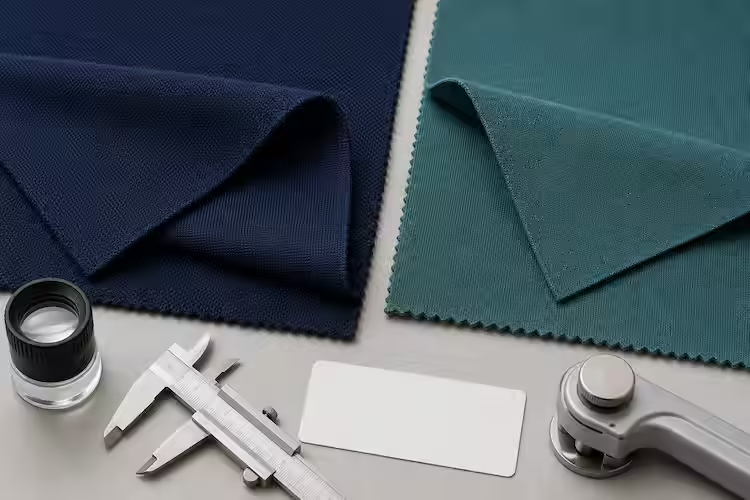
Catalogue confirmation
A listed article is a sourcing reference, not a blanket inventory promise. Confirm the exact article, colour, usable quantity, finish and commercial terms directly with the sales team.
Browse by construction need
These routes explain the garment use and finished-sample checks behind four common knit directions. Use them to prepare a clearer inquiry, then confirm the exact article, colour and quantity privately.
Cotton jersey fabric is a single-knit construction with vertical V-shaped stitch legs on the smooth technical face and horizontal stitch crowns on the more textured technical back, commonly specified for T-shirts, base layers, loungewear and private-label basics.
Cotton spandex jersey fabric is a single-knit construction combining cotton and spandex for fitted tees, childrenswear, loungewear and other movement-led apparel, subject to exact article and finished-sample review.
French terry fabric is a knitted sweatshirt fabric with a smooth face and visible loop-back reverse, commonly specified for hoodies, sweatshirts, joggers, shorts and loungewear.
Structured knitted fabrics for hoodies, jackets and garments that need body and shape retention.
Availability decision record
The public catalogue starts the sourcing conversation. A supply decision is complete only after the article, sample and order conditions have been checked for the buyer's programme.
Match the garment use to a documented article number, composition, GSM, usable width and construction series. Share a reference swatch when the catalogue record is only an approximate match.
Confirm colour, finish, hand feel, stretch, recovery and required testing on the actual sample. A catalogue listing does not replace buyer approval of the finished result.
Sales confirms live quantity, sample route, lead time, price basis, destination and documentation against the current inquiry. No public article record is a fixed inventory promise.
Ready-stock sourcing is a sequence of checks, not a claim attached permanently to a web page. The public record lets a buyer identify a relevant finished-fabric direction. The sales confirmation then connects that reference to a sample, a current quantity and a defined order.
State the garment category, silhouette, season and end market. Include the behaviour that matters most, such as breathability, warmth, stretch, recovery, body, drape, surface texture or dimensional stability. This separates the functional requirement from a broad fabric name and helps sales identify the closest construction family.
When available, attach a reference swatch, garment image or existing specification. Describe which features must be matched and which can be adjusted. A clear benchmark makes the first sample discussion more useful than a request for a generic jersey, interlock, fleece or air-layer fabric.
Use the public article number, composition, GSM, usable width and series to form a shortlist. These fields are evidence from the supplied catalogue, but they do not establish colour, hand feel, finish or performance for a new order. Quote the exact article number in the inquiry so the buyer and sales team are discussing the same reference.
If several records appear suitable, explain the trade-off being evaluated. For example, a buyer may be comparing lower weight with opacity, softer hand with recovery, or extra structure with seam bulk. This gives the supplier a reason to recommend one sample route over another.
Confirm the sample in the requested colour and finish whenever those variables affect the garment result. Review hand feel, face and back appearance, drape, stretch, recovery and usable width. Align shrinkage, pilling, colourfastness and other tests with the destination market and intended care instructions.
Record the approved sample reference and the conditions under which measurements were taken. This avoids using a catalogue value as a substitute for the finished approval standard and gives both sides a clearer basis for later production discussion.
Provide required quantity, colour allocation, delivery destination, timing request, price basis and documentation needs. Sales can then confirm the current usable quantity, whether sampling or additional production is required, and which commercial terms apply to that specific inquiry.
Treat the written confirmation for the inquiry as the live decision point. Catalogue publication dates and article descriptions support discovery, but they cannot guarantee that an unchanged quantity remains available for every buyer, colour and delivery window.
Confirm whether the target is an existing finished-fabric article, a modified finish or a new development. State the acceptable composition and GSM ranges, the required usable width and any non-negotiable surface or performance requirement. If the programme can accept alternatives, identify which fields may move and by how much.
Explain how the fabric will be cut, sewn, washed and tested. Garment engineering can expose issues that are not obvious in a small swatch, including seam bulk, edge curling, growth, torque, opacity and recovery. Sharing these conditions helps the supplier evaluate the article in the context that matters to the buyer.
Finally, provide quantity by colour, destination, target schedule, packaging needs and required certificates or test reports. Certification details can be reviewed privately when relevant to the programme. The resulting quotation should refer to the selected article or approved development, not to a broad category page alone.
Keep the article reference, sample approval, testing scope and commercial confirmation in one decision record. Note any later change to composition, GSM, usable width, colour, finish or quantity as a new revision. This makes it clear which evidence supported the quoted route and prevents an earlier catalogue screenshot from being mistaken for a current supply commitment.
Supplied finished-fabric catalogue
Use the series and specification filters to identify a relevant article, add it to the inquiry, and confirm live commercial details with the sourcing team.
Showing 4 fabrics | Available by inquiry
Loading the complete 104-article catalogue...
45% polyester, 25% combed cotton, 24% modal, 6% elastane
Documented air-layer article GD2515. Confirm colour, finish, quantity, testing and commercial terms with the sourcing team.
Confirm current details by inquiry
67.6% polyester, 13.6% viscose, 7.7% nylon, 5.3% acrylic, 4.1% elastane, 1.7% wool
Documented yarn-dyed wool-blend air-layer article GD2672. Confirm colour, finish, quantity, testing and commercial terms with the sourcing team.
Confirm current details by inquiry
85% polyester, 12% viscose, 3% elastane
Documented structured polyester-viscose article 6128. Confirm colour, finish, quantity, testing and commercial terms with the sourcing team.
Confirm current details by inquiry
27.7% polyester, 20.7% nylon, 48.5% viscose, 3.1% elastane
Documented faux-cashmere article GD2502. Confirm colour, finish, quantity, testing and commercial terms with the sourcing team.
Confirm current details by inquiry
Catalogue questions
No. The catalogue confirms an active product direction. Exact colour, quantity, finishing and commercial terms are confirmed privately for the current inquiry.
Yes. Include the garment use and the properties that need to be evaluated so the team can identify a relevant sample.
Include the article, colour, quantity, destination and any testing, packing or documentation requirements. The sales team will confirm the next step directly.
Yes. Those requirements are handled through a direct inquiry because the required construction, garment brief and commercial scope need to be reviewed privately.
Share the garment use, construction, composition, target GSM, usable width, colour, finish, quantity and destination. Commercial terms remain subject to the current sample and quotation.
Shaoxing Shicheng Textile Products Co., Ltd. supports overseas buyers with finished knit and woven fabric samples, development direction and RFQ follow-up.