Knit construction comparison
Interlock vs Jersey Fabric for Apparel Sourcing
Interlock vs jersey fabric compares a double-knit construction with a single-knit direction. Interlock normally has two smooth-looking faces, more stability and less edge curl, while single jersey is usually lighter, more flexible and more prone to curling. Buyers should compare the exact finished samples because fibre, density, GSM and finishing can change both results.
Updated 2026-07-26 · Reviewed by O'range Textile sourcing team
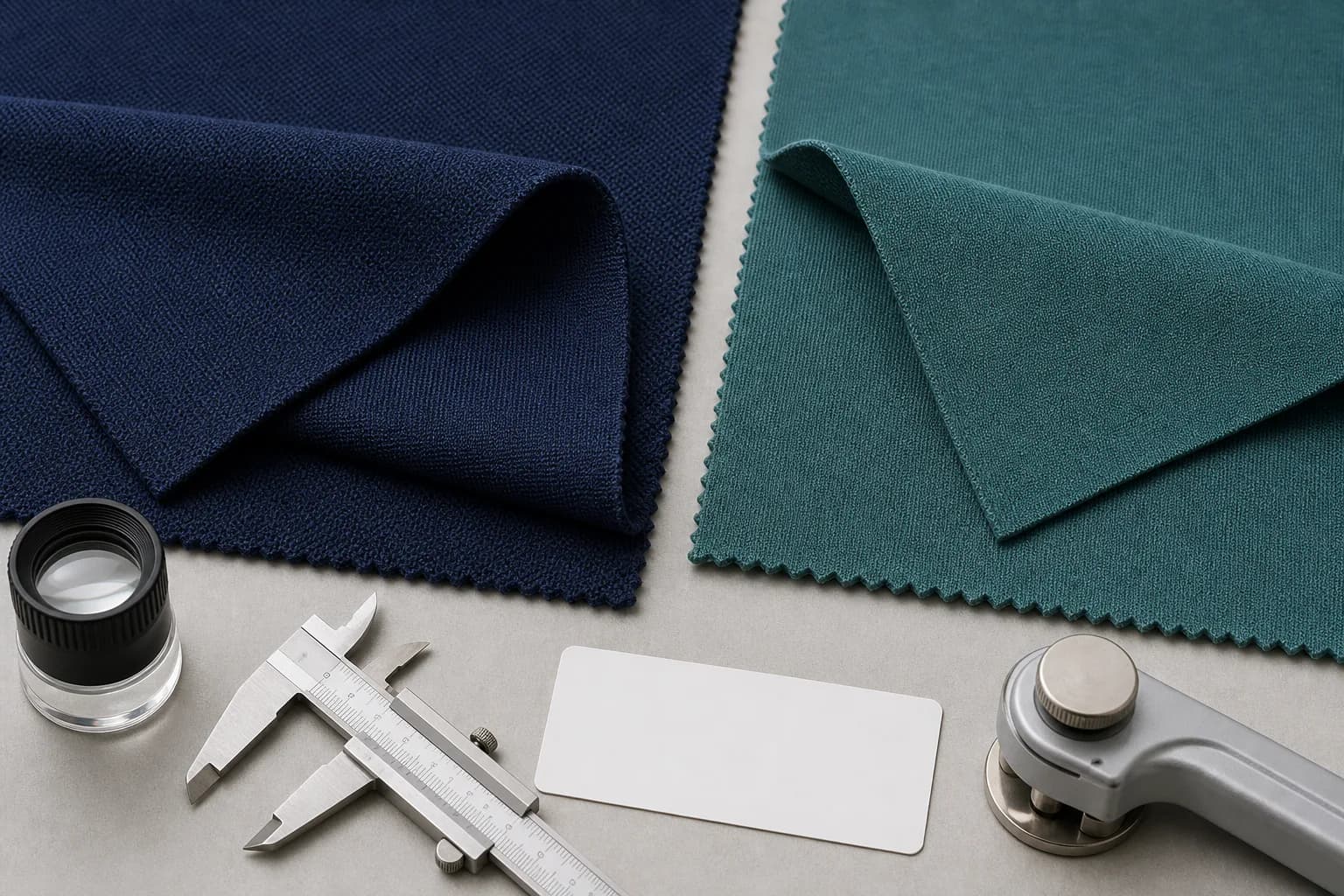
Identify the construction before comparing performance
Single jersey is produced as a single-knit structure with a knit face and a different loop appearance on the reverse. Its edges commonly curl, and the material can show more torque or spirality depending on yarn, density and finishing. Interlock is a double-knit construction created with two needle systems. It normally presents a smoother appearance on both sides and greater edge stability.
These descriptions are useful starting points, not guarantees. A dense cotton jersey can feel firmer than a light interlock, and elastane can change stretch and recovery in either family. Finishing can change hand, width, shrinkage and surface. Ask the supplier to identify the exact construction and provide face-and-reverse evidence for the offered sample.
- Photograph and label the face and reverse.
- Confirm whether the structure is single knit or interlock double knit.
- Record complete composition, GSM and usable width.
- Observe edge curl, stretch direction, recovery and opacity.
- State any compacting, brushing, printing or other finish.
Match stability and drape to the garment
Jersey is often selected for T-shirts, base layers and soft garments that benefit from lighter body and drape. Interlock can suit premium T-shirts, childrenswear, dresses, polos, lining directions or other garments that need more coverage, a smooth inside and greater stability. These are common routes, not limits.
The pattern and construction method matter. Edge curl can affect cutting and hemming on jersey. Added interlock thickness can affect seam bulk and heat transfer. Compare opacity, print surface, collar recovery, shoulder stability and side-seam behaviour for the actual garment. A material that performs well in one silhouette is not automatically the better choice for another.
| Buyer field | Single jersey direction | Interlock direction |
|---|---|---|
| Structure | Single knit with different face and reverse | Double knit with two smooth-looking sides |
| Typical body | Lighter and more fluid | Fuller, stable and more covering |
| Edge behaviour | More likely to curl | Usually lies flatter |
| Priority checks | Spirality, curl, opacity and drape | Thickness, seam bulk, recovery and stability |
| Common route | T-shirts, base layers and soft basics | Premium basics, childrenswear and stable knit garments |
Run the same sample checks on both candidates
Condition both samples before measuring. Record article, colour, finish, date and version. Measure GSM and usable width with the same method. Compare stretch and rested recovery in the relevant directions. Review opacity under the garment's real colour and lighting conditions. Measure shrinkage and spirality after the intended laundering process.
Sew the actual neckline, shoulder, side seam and hem. Check edge handling, skipped stitches, seam grin, feed balance and press response. Add the intended print, embroidery or heat process. Evaluate drape, fit and recovery on a garment or panel rather than only by stretching a small swatch by hand.
- 01Confirm construction and article identity for each candidate.
- 02Condition, measure and photograph face and reverse.
- 03Run dimensional, stretch, recovery, opacity and colourfastness checks.
- 04Sew and process the critical garment details.
- 05Approve one dated material and document the reasons for selection.
Keep the RFQ specific to the chosen construction
The RFQ should name interlock or single jersey and attach the approved sample reference. Include complete composition, target GSM, usable width, colour, finish, stretch, recovery, shrinkage, spirality, opacity, pilling, colourfastness and care. Add garment type, quantity, destination, testing, inspection, packing and documentation.
If the supplier proposes an alternative, require the changed fields to be identified and review it as a new sample. Current availability, sample terms, MOQ, lead time, price, payment, packing and shipping basis are confirmed for the actual article and order. This protects the construction decision from being diluted during quotation.
Article evidence snapshot
Choose from construction, garment result and measured evidence
The interlock-versus-jersey decision is not a universal quality ranking. Interlock can offer coverage, stability and a smooth reverse; jersey can offer lighter weight, drape and economical simplicity. The buyer should identify the construction, record composition, GSM, usable width, stretch, recovery, shrinkage and spirality, then sew and wash the intended garment before approving one route.
- Interlock evidence
- Confirm the double-knit structure, face and reverse, edge behaviour, coverage, GSM, width and recovery when the garment needs a cleaner inside or greater stability.
- Jersey evidence
- Confirm the single-knit face and reverse, curl, drape, opacity, torque, GSM, width and recovery when the garment prioritises lighter body and flexible movement.
- Garment evidence
- Test the neckline, hem, side seam, shoulder and print or embroidery process, then measure appearance and dimensions after the intended care route.
Evidence boundary
This guide explains interlock and jersey construction decisions. Exact article identity, composition, GSM, usable width, colour, finish, testing, live availability, sample terms, quantity, MOQ, lead time, price, packing and shipping require current confirmation for the selected fabric and inquiry.
Buyer questions
Frequently asked questions
Is interlock thicker than jersey fabric?
Interlock commonly has more body because it is a double-knit construction, but exact thickness depends on yarn, density, GSM and finish. Compare conditioned finished samples.
Does interlock fabric curl at the edges?
Interlock normally has better edge stability and less curl than single jersey. Cutting and sewing trials should still confirm the behaviour of the exact article.
Which fabric is better for T-shirts?
Jersey can suit light, drapey T-shirts; interlock can suit smoother, more covering and stable T-shirts. Fit, season, opacity, drape, price and testing determine the better route.
Can cotton spandex jersey replace interlock?
Not automatically. Elastane can improve jersey stretch and recovery, but it does not make the structure interlock. Compare construction, coverage, curl, thickness, recovery and garment performance.
Move from category research to a sample brief
Share the garment use, construction direction, composition, target GSM, usable width, color, finish and tests that matter. The team can then confirm the appropriate article and quotation route.