Air-layer sourcing guide
Air Layer Knit Fabric Sourcing Guide for Apparel Buyers
Air-layer knit fabric should be sourced by article evidence, not by the category name alone. Start with the required garment structure, then compare composition, GSM, usable width, recovery and finished-sample behaviour before requesting current commercial confirmation.
Updated 2026-07-28 · Reviewed by O'range Textile sourcing team
Start with the garment result, not the air-layer label
Air-layer is a commercial family name used for structured finished knits. It does not prove one universal loop arrangement, thickness or performance level. A buyer should define the garment, silhouette, season, target body, stretch direction, recovery, surface, care route and sewing method before choosing an article.
The catalogue provides several evidence points. GD2515 is recorded at 300 GSM and 160 cm with 45% polyester, 25% combed cotton, 24% modal and 6% elastane. GD2518 is a lighter 260 GSM direction at 160 cm. These records show real variety inside the category; they do not make the articles interchangeable.
- State whether the garment needs crisp structure, soft volume, stretch, warmth or shape retention.
- Name the intended panels, seams, trims, lining, printing, bonding or embroidery.
- Separate required properties from fields where the supplier may propose alternatives.
- Use the exact article number on samples, test records and quotation discussions.
Compare article evidence before requesting samples
Use composition, GSM and usable width to narrow the catalogue, then inspect the complete finished sample. A 260 GSM air-layer and a 300 GSM air-layer may differ in body, compression, drape, opacity and sewing response even when both are described with the same market term.
GD2672 is a yarn-dyed wool-blend air-layer article recorded at 360 GSM and 160 cm. Its composition includes polyester, viscose, nylon, acrylic, elastane and wool. This is a distinct direction from cotton, modal or lyocell blends and should be evaluated for colour construction, hand, pilling, care and garment use on its own evidence.
| Catalogue example | Recorded specification | Buyer decision |
|---|---|---|
| GD2515 | 300 GSM; 160 cm; polyester/cotton/modal/elastane | Review body, recovery, seams and intended apparel use |
| GD2518 | 260 GSM; 160 cm; polyester/cotton/lyocell/elastane | Compare lighter structure, drape and opacity |
| GD2672 | 360 GSM; 160 cm; yarn-dyed wool-blend air-layer | Confirm colour construction, surface, pilling and care |
Approve the finished sample with measurable checks
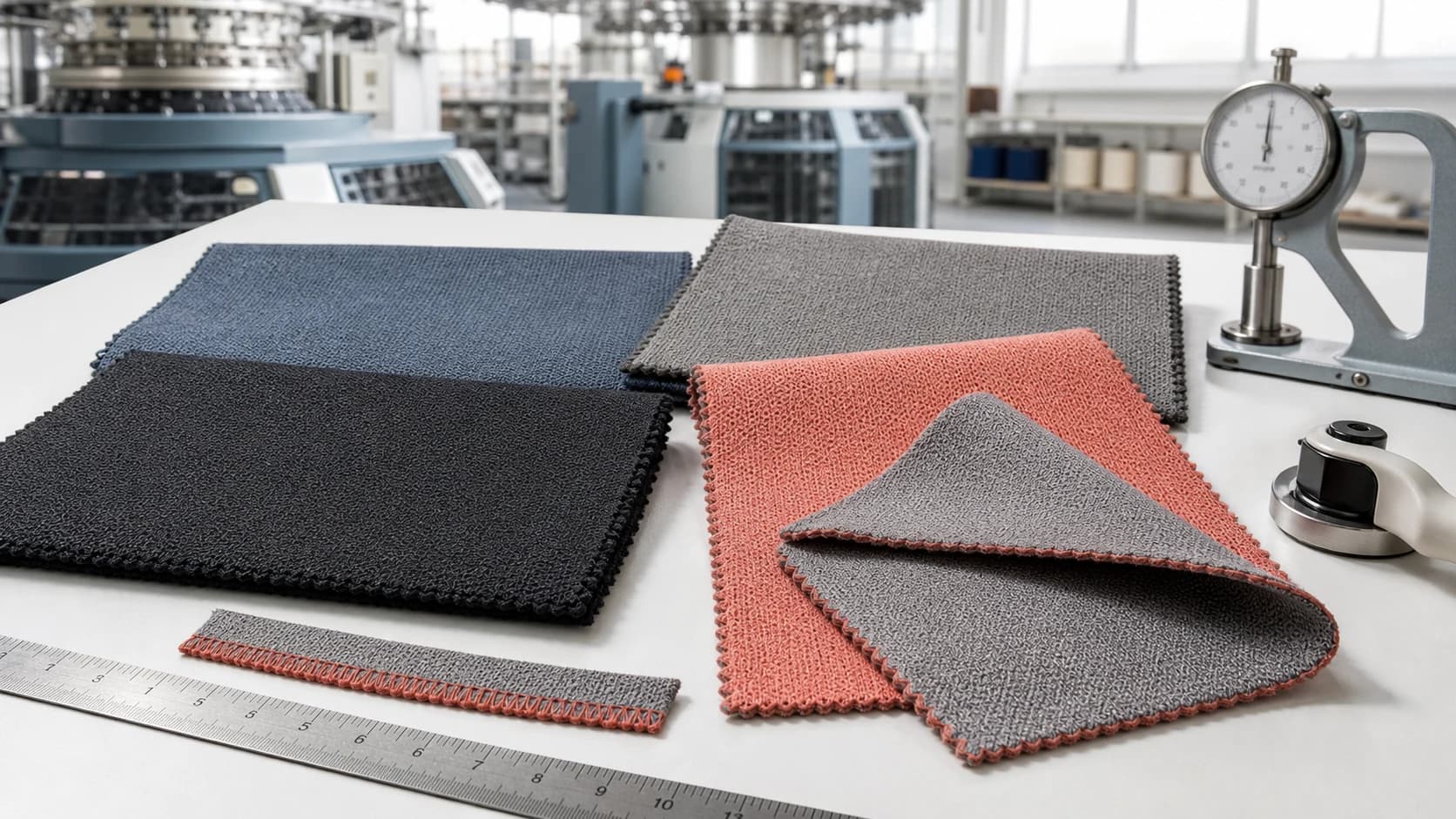
A useful sample review covers face and reverse, thickness, compression, crease recovery, extension, rested recovery, usable width, GSM and colour. Sew the intended seam and inspect bulk, puckering, needle marks, pressing response and shape after laundering. Record the method and result instead of relying on adjectives such as premium or stable.
Sample approval confirms the physical reference reviewed by the buyer. It does not automatically confirm every production colour, order quantity or delivery window. Link the approved swatch to a dated specification and list any test or shade approvals that remain open.
- 01Label the swatch with supplier, article, colour, date and version.
- 02Measure GSM and usable width by the agreed method.
- 03Inspect face, reverse, thickness, recovery and surface consistency.
- 04Sew and wash a garment-relevant trial.
- 05Record sample approval and unresolved production conditions.
Write an air-layer RFQ that can be answered
Send the article reference or closest benchmark, garment type, composition direction, target GSM, usable width, colour, finish, stretch and recovery needs, testing, quantity and destination. Add clear images of the face, reverse and garment if a physical swatch cannot be sent first.
Ask the supplier to separate article data from current commercial confirmation. The response should identify the proposed article, available sample route and any requested alternatives. Live availability, colour, quantity, price, MOQ, lead time, packing, documentation and shipping are confirmed for the current inquiry.
Article evidence snapshot
Read three air-layer articles as different sourcing decisions
The catalogue does not treat air-layer knit as one fixed specification. GD2515, GD2518 and GD2672 share a 160 cm recorded usable-width direction, yet their composition and weight records lead to different questions about body, drape, recovery, colour construction and care. Use these entries to shortlist samples, not to infer current stock or final performance.
- GD2515: structured multi-fibre direction
- The catalogue records 300 GSM and 160 cm with polyester, combed cotton, modal and elastane. Review body, recovery, seams and the intended apparel panel on the labelled sample.
- GD2518: lighter comparison point
- The catalogue records 260 GSM and 160 cm with polyester, combed cotton, lyocell and elastane. Compare drape, opacity and recovery under the same sample conditions used for the heavier option.
- GD2672: yarn-dyed wool-blend route
- The catalogue records 360 GSM and 160 cm. Confirm the full composition, colour construction, surface, pilling and care route before treating it as an approved garment fabric.
Evidence boundary
Article numbers, compositions, GSM values and width references come from the supplied 104-record finished-fabric catalogue. Colour, finish, live availability, sample terms, testing, packing, quantity, lead time, price and other commercial conditions require current confirmation for the specific inquiry.
Buyer questions
Frequently asked questions
Is every air-layer knit a spacer fabric?
No. Air-layer is a commercial category name and does not by itself prove a spacer construction. Confirm the exact loop or layered structure, face, reverse, thickness and finished behaviour for the proposed article.
Which GSM should an air-layer buyer choose?
Choose GSM with the garment silhouette, season, opacity, body and drape. The catalogue includes examples from 260 GSM to heavier directions, but the physical sample and garment trial should decide suitability.
What does usable width mean in an RFQ?
Usable width is the cuttable width agreed for planning consumption, excluding edges that cannot be used. Confirm the measurement method and production tolerance for the exact finished article.
Does a catalogue article guarantee stock?
No. A catalogue record documents a sourcing direction. Live colour, quantity, sample availability and commercial terms require confirmation when the buyer sends the current inquiry.
Move from category research to a sample brief
Share the garment use, construction direction, composition, target GSM, usable width, color, finish and tests that matter. The team can then confirm the appropriate article and quotation route.