RFQ template guide
Knit Fabric RFQ Template for a Complete Sourcing Brief
A useful knit fabric RFQ identifies the garment, construction or article, complete composition, target GSM, usable width, colour, finish, performance tests, quantity and destination. It also separates sample approval from the commercial conditions that require a current quotation.
Updated 2026-07-28 · Reviewed by O'range Textile sourcing team
Begin with the garment and decision context
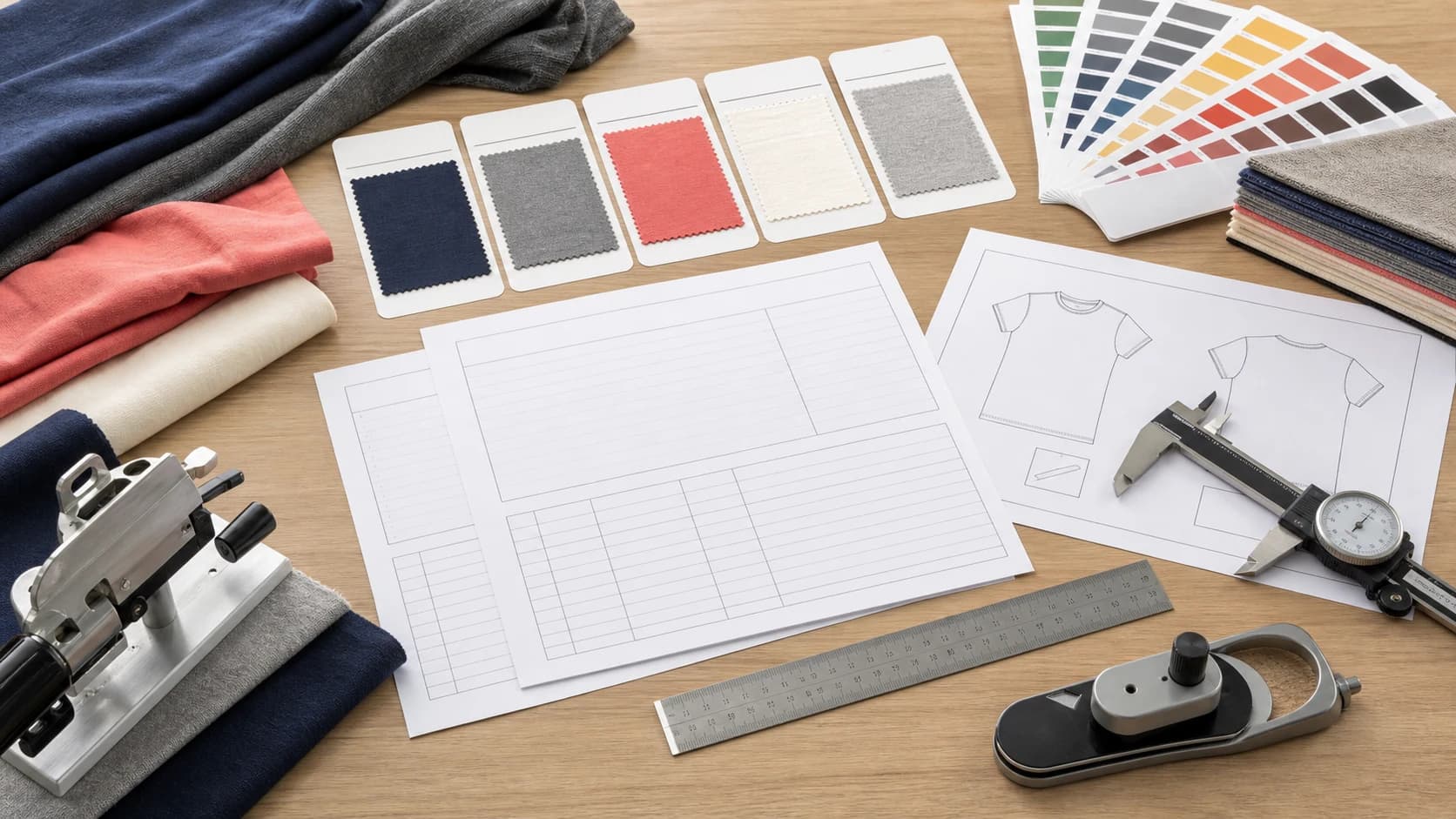
Name the garment, target market, season, silhouette and panels where the fabric will be used. Attach a reference garment, swatch, technical sketch or article number when available. Explain which properties are fixed and where the supplier may propose an alternative.
A category name such as air-layer, Ponte, rib or jacquard is not a full specification. Add the required structure, face and reverse, stretch direction, recovery, opacity, drape, surface and care route so the supplier can evaluate fit.
- Garment type, end use, season and destination market
- Construction family or exact catalogue article
- Reference swatch, garment, image or technical drawing
- Fixed requirements and acceptable proposal fields
- Buyer contact and decision timeline
Record measurable fabric specifications
State complete composition, target GSM, usable width, colour, finish and required tolerances. Add repeat dimensions for jacquard, pile direction for raised surfaces, and stretch or recovery methods for elastic constructions. If a field is unknown, request a proposal instead of inventing a value.
Catalogue examples show why exact fields matter. GD2515 is 300 GSM and 160 cm; GD2579 is 240 GSM with a 160-165 cm width reference; GD2683 is 280 GSM with the same width range. Similar category names do not make these articles equivalent.
| RFQ field | What to provide | What to confirm |
|---|---|---|
| Identity | Construction, article or reference sample | Exact proposed article and version |
| Material | Complete composition and required verification | Written article declaration |
| Dimensions | Target GSM and usable width | Method, tolerance and finished result |
| Appearance | Colour, face, reverse, finish, repeat or pile | Approved shade and surface sample |
| Performance | Tests, methods and acceptance criteria | Sample or production result |
| Commercial | Quantity, destination and timing need | Price, MOQ, lead time, packing and shipping |
Define sample approval and testing
Ask for a labeled sample with supplier, article, colour, date and version. State the minimum sample size needed for repeat, width, garment panel, washing or laboratory checks. List the test methods and acceptance criteria that apply to the buyer's market and garment.
Record observations and measured results separately. A sample can be approved for hand and appearance while laboratory or bulk shade checks remain open. The approval note should identify what was accepted and what must still be confirmed.
- 01Receive and label the proposed finished sample.
- 02Verify article data and measure agreed physical fields.
- 03Run garment, care and buyer-required tests.
- 04Approve one dated sample version.
- 05List unresolved production and commercial conditions.
Request commercial confirmation without guessing terms
Include estimated quantity, colour plan, destination, packaging, documentation, inspection and timing needs. Ask sales to respond with the current article availability, sample route, price basis, MOQ, lead time, payment, packing and shipping conditions.
Do not treat catalogue inclusion as a live-stock guarantee. The catalogue supports discovery and technical comparison. The current quotation is the record for commercial confirmation, and production should reference the same approved sample and specification.
Article evidence snapshot
Build one RFQ record that can survive sample revisions
An actionable knit-fabric RFQ distinguishes facts that identify the requested article from fields that remain open for supplier confirmation. It also gives every sample revision a traceable decision record. This prevents a catalogue name, old message or reference image from becoming an accidental production specification and lets technical, commercial and logistics questions be answered in the correct order.
- Identity and garment context
- State the article or construction direction, garment panel, intended use, complete composition requirement and any reference property that must be matched.
- Measurable approval fields
- Record target GSM, usable width, colour, face and reverse, finish, stretch or recovery, care route, test method and the dated sample version used for approval.
- Current commercial confirmation
- Ask sales to confirm quantity, colour split, destination, sample timing, live availability, packing, documentation, lead time, price and payment terms for the current inquiry.
Evidence boundary
Article numbers, compositions, GSM values and width references come from the supplied 104-record finished-fabric catalogue. Colour, finish, live availability, sample terms, testing, packing, quantity, lead time, price and other commercial conditions require current confirmation for the specific inquiry.
Buyer questions
Frequently asked questions
What is the minimum information for a knit fabric RFQ?
Provide garment use, construction or article, composition direction, GSM, usable width, colour, finish, quantity and destination. Add testing, sample and timing needs when known.
Should a buyer specify usable width or total width?
Use usable width for consumption planning and state the measurement method. The supplier should confirm the finished production tolerance for the proposed article.
Can a buyer request an alternative article?
Yes. Mark proposal fields clearly and ask the supplier to identify every changed specification. Review the alternative as a new labeled sample rather than assuming equivalence.
When are MOQ and lead time confirmed?
MOQ and lead time are commercial conditions confirmed for the current article, colour, quantity and order context. They should come from the current quotation, not a generic content page.
Move from category research to a sample brief
Share the garment use, construction direction, composition, target GSM, usable width, color, finish and tests that matter. The team can then confirm the appropriate article and quotation route.