Fabric testing guide
Finished Knit Fabric Testing Before Bulk Production
What testing should finished knit fabric pass before bulk production?
Test results do not apply to every knit fabric order. The items chosen depend on the use of the finished garment and the target market. How a test is judged as a pass has to be agreed between buyer and seller as an acceptance standard.
Updated 2026-11-13 · Reviewed by O'range Textile sourcing team
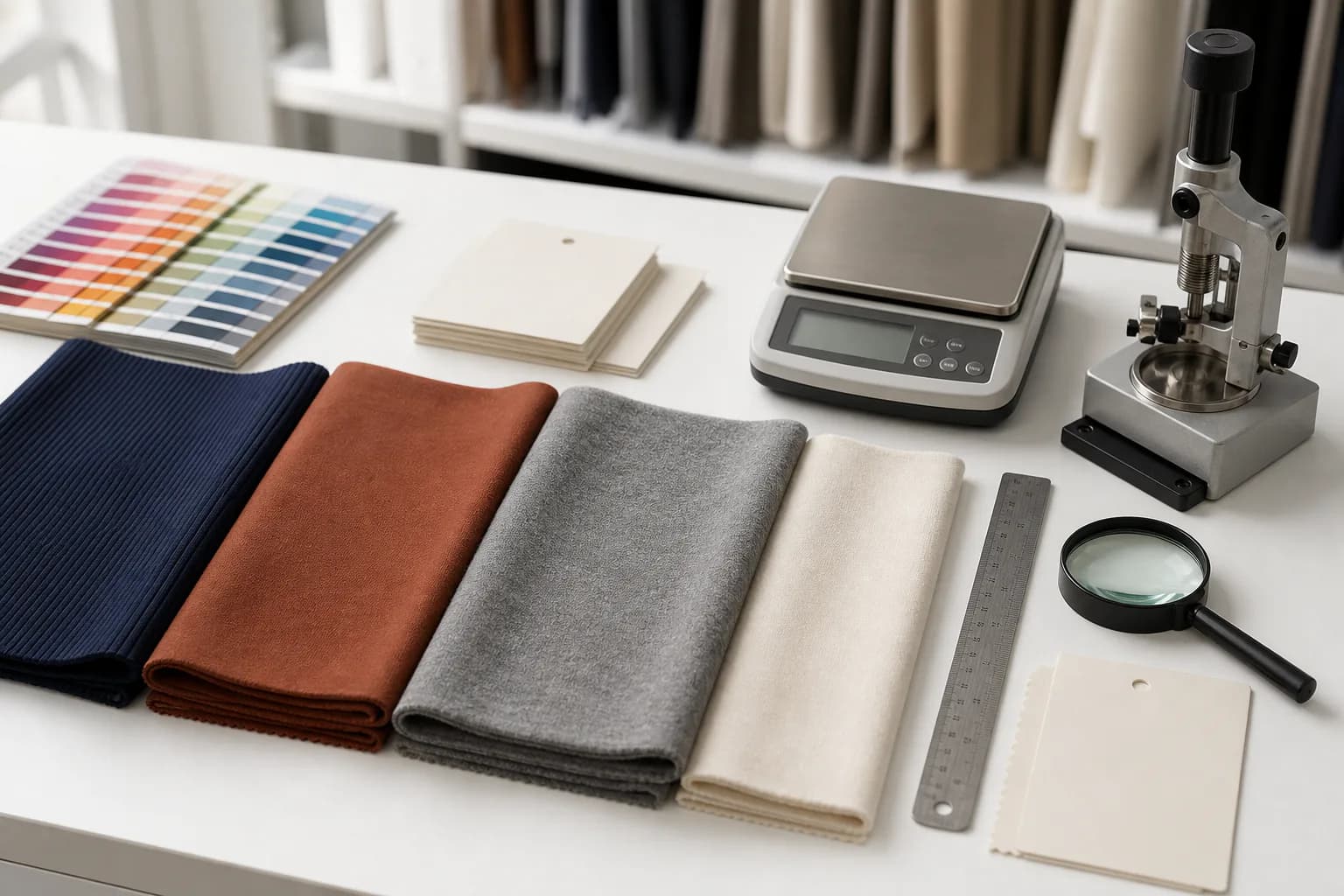
1. Why test at all?
An article published by ECQA in October 2024, "Why Is Pre-Shipment Inspection Important?", explains the role of pre-shipment inspection (PSI), what is usually checked and the process.
Of course, that can only serve as a purchasing reference for the buyer, as a way to avoid risk.
Note that even if the fabric is accepted, this does not mean the final product is fully acceptable! Finished garments made after the fabric is cut, sewn and washed may still fail the performance requirements.
2. When the fabric is tested
Samples at different stages mean different things. The buyer needs to understand what each sample can show.
First point: the approval sample
The sample is made to the artwork, color card standard and technical process chosen by the buyer. It is tested to verify the core performance of the fabric structure, composition and color matching. The test results secure the technical requirements of the formal order. (They cannot guarantee the actual performance of the final production lot.)
Second point: the pre-production sample, also called the first dye lot
The sample comes from a batch made before bulk production. Likewise, it reflects the real level of production. The sample's parameters can be tested from this angle, and if there is a deviation a small adjustment can be requested.
Third point: lot testing after the bulk fabric is finished.
Samples are taken from the lot and tested to check that performance is stable. Even if earlier sampling passed, this inspection step cannot be skipped, because the finished fabric is used to check quality variation caused by dye lots and equipment differences.
Core fabric indicators before bulk release
The limits below for skew, pilling, shrinkage and colorfastness come from the buyer manual Spotlight v3.0. They are a buyer's acceptance requirements, not test results for the articles listed.
The reference conditions are for machine-washable wool and fine knit fabrics. Care conditions, knit structure and order limits for each article must be confirmed by buyer and seller.
Specific test indicators can be agreed by both parties.
| Article | Weight | Width (cm) | Fabric | Skew | Pilling | Shrinkage | Colorfastness |
|---|---|---|---|---|---|---|---|
| GD2579 | 240 GSM | 160–165 | Wool-blend jacquard | ≤7% after 3 washes; applies to single jersey only | Grade 4 after 1 machine wash; ICI pilling box, 4 hours | Within ±5% in length and width; 3 gentle washes at 40°C, flat dry | Washing at 40°C: color change ≥4, staining on cotton ≥3–4, staining on nylon ≥4. Crocking: dry ≥4, wet ≥3 |
| GD2583 | 240 GSM | 160–165 | Wool-blend jacquard | ≤7% after 3 washes; applies to single jersey only | Grade 4 after 1 machine wash; ICI pilling box, 4 hours | Within ±5% in length and width; 3 gentle washes at 40°C, flat dry | Washing at 40°C: color change ≥4, staining on cotton ≥3–4, staining on nylon ≥4. Crocking: dry ≥4, wet ≥3 |
| GD2681 | 240 GSM | 160–165 | Wool-blend jacquard | ≤7% after 3 washes; applies to single jersey only | Grade 4 after 1 machine wash; ICI pilling box, 4 hours | Within ±5% in length and width; 3 gentle washes at 40°C, flat dry | Washing at 40°C: color change ≥4, staining on cotton ≥3–4, staining on nylon ≥4. Crocking: dry ≥4, wet ≥3 |
| GD2683 | 280 GSM | 160–165 | Wool-blend jacquard | ≤7% after 3 washes; applies to single jersey only | Grade 4 after 1 machine wash; ICI pilling box, 4 hours | Within ±5% in length and width; 3 gentle washes at 40°C, flat dry | Washing at 40°C: color change ≥4, staining on cotton ≥3–4, staining on nylon ≥4. Crocking: dry ≥4, wet ≥3 |
How to read a fabric test report correctly
First check that the article number and the dye lot or batch number match your order.
The batch number is the main information for identifying a bulk lot and needs special attention.
Next, confirm the sample status: whether the tested sample is a pre-production sample or was taken from bulk rolls. Finally, check carefully the test standard number and version, the testing body, the units of measurement, the report date, the measured values and the pass thresholds agreed in advance. If the wrong acceptance standard is used for comparison, the final test values mean nothing.
Summary:
A sample that has been through bulk testing should not be held to absolute compliance; what needs to be tested is the performance of the finished garment against the buyer's expected results. Test standards provide a uniform rule of measurement, but what finally counts as acceptable goods is decided by the buyer's use requirements.
Sources
- ECQA Inspection, "Why Is Pre-Shipment Inspection Important?" (17 October 2024), https://www.ecqa.cn/h-nd-1572.html
- Buyer manual Spotlight v3.0, September 2010, page 12.
- The weight and width of the four articles are from the factory's article list.
- ASTM D3887-96(2008), Standard Specification for Tolerances for Knitted Fabrics (withdrawn 2017, no replacement; checked 13 November 2026), https://store.astm.org/d3887-96r08.html
About O'range Textile:
Testing arrangements are confirmed at the quotation stage for the specific article. The full test scope, report format, testing time and related costs all need to be confirmed in writing before the order starts.
Buyer questions
Frequently asked questions
Where do the limits in the table come from?
From the buyer manual Spotlight v3.0, September 2010, page 12. They are that buyer's acceptance requirements, not test results for GD2579, GD2583, GD2681 or GD2683.
What weight and width are the four articles in the table?
GD2579, GD2583 and GD2681 are 240 GSM and GD2683 is 280 GSM. All four are 160 to 165 cm wide.
Is ASTM D3887 still the current tolerance standard for knit fabrics?
No. The ASTM page states that this specification for knitted fabric tolerances was withdrawn in 2017 and has no replacement. So tolerances have to be agreed between buyer and seller.
Move from category research to a sample brief
Share the garment use, construction direction, composition, target GSM, usable width, color, finish and tests that matter. The team can then confirm the appropriate article and quotation route.