Surface finish guide
Brushed Knit Fabric Finishes and Raised-Pile Sourcing Checks
Brushed knit fabric finishes change hand, appearance, bulk and care behaviour without proving fibre content or durability. Buyers should identify the base construction and article, inspect face and reverse, then verify shedding, pilling, GSM, usable width, colour and care on the finished sample.
Updated 2026-07-28 · Reviewed by O'range Textile sourcing team
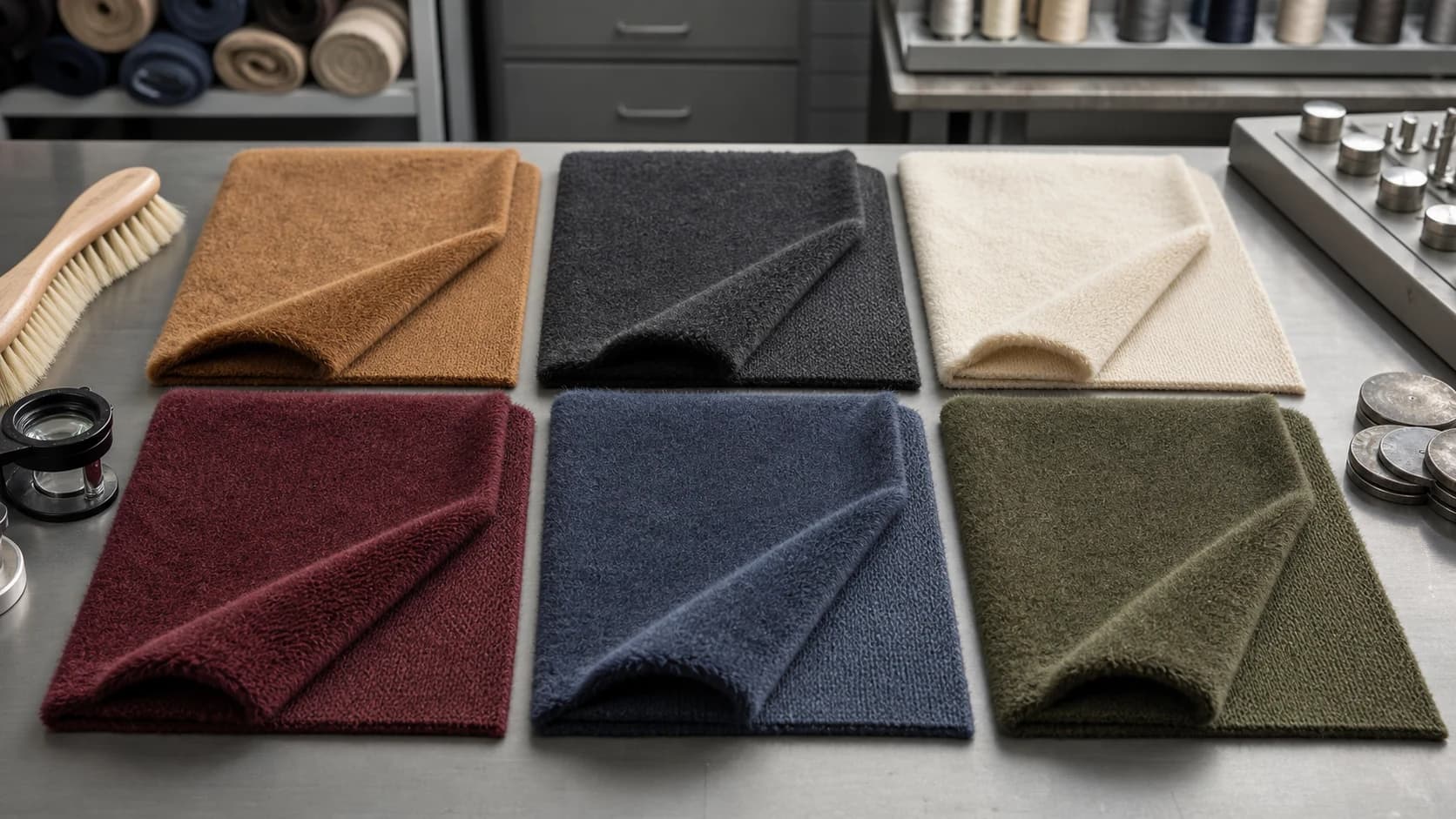
Separate base construction from surface finish
Brushing, raising and pile development alter the surface of a knit, while the underlying construction and composition still control stretch, recovery, stability and sewing response. A soft hand does not identify the fibre blend. Ask for the article number, full composition and finish description together.
The catalogue contains faux-cashmere, acetate brushed and raised-pile series. These labels describe sourcing directions, not a universal performance claim. GD2706 is an acetate-brushed article recorded at 250 GSM; GD2650 is a raised-pile article recorded at 240 GSM and 165 cm.
- Identify the base knit and the surface treatment.
- Record complete composition rather than inferring fibre from hand.
- Photograph face, reverse and pile direction under consistent light.
- Confirm whether brushing or raising occurs on one side or both.
- Keep article and colour attached to every sample and test.
Compare documented finish directions
A faux-cashmere direction can produce a soft impression without containing cashmere. A cashmere-blend article should state cashmere in the actual composition record. The buyer must preserve this distinction in product copy, care labels and sourcing decisions.
Raised-pile GD2650 is recorded at 240 GSM and 165 cm. GD2652 is recorded at 250-260 GSM and 165 cm. Acetate-brushed entries may require usable width confirmation. These differences affect RFQ completeness and sample planning.
| Finish direction | Catalogue evidence | Required confirmation |
|---|---|---|
| Acetate brushed | GD2706; 250 GSM | Usable width, face/reverse, brushing and care |
| Raised pile | GD2650; 240 GSM; 165 cm | Pile direction, shedding, pilling and seam response |
| Raised pile | GD2652; 250-260 GSM; 165 cm | Body, recovery, surface consistency and colour |
| Faux-cashmere | GD2502; 280 GSM; 155-160 cm reference | Full composition and no unsupported cashmere claim |
Test pilling, shedding and appearance after care
Inspect loose fibre, pile direction, streaks, shade, crush marks and surface consistency before testing. Run the buyer-required pilling, abrasion, shedding, colourfastness and dimensional methods, then compare appearance after the intended wash, dry, press or dry-clean route.
A garment trial should include seam and edge areas because surface and bulk may change under stitching or pressing. Record any appearance difference between panels cut in opposite directions. If pile direction matters, add a one-way cutting note to the garment specification.
- 01Label and photograph the original finished sample.
- 02Inspect face, reverse, pile direction and loose fibre.
- 03Measure GSM and usable width.
- 04Run relevant surface, colour and dimensional tests.
- 05Approve appearance after the intended garment care route.
Create a finish-specific sample and RFQ record
State base construction, exact composition, article or benchmark, GSM, usable width, face and reverse finish, pile direction, colour, garment, quantity, destination, testing and care requirements. Include expected surface appearance after laundering or wear.
Ask sales to confirm the proposed article, sample route and any alternative. Sample approval covers the reviewed physical reference. Current availability, colour, quantity, price, MOQ, lead time, packing, documentation and shipping require commercial confirmation.
Article evidence snapshot
Separate the base article from the raised-surface finish
The catalogue includes acetate-brushed, raised-pile and faux-cashmere directions, but those labels describe different evidence and approval questions. GD2706, GD2650, GD2652 and GD2502 cannot be compared by softness alone. A buyer needs the full composition, face and reverse, pile direction, recorded weight and width, then must test shedding, pilling, seams and care on the exact finished sample.
- GD2706: acetate-brushed direction
- The catalogue records 250 GSM. Confirm usable width, full composition, face and reverse, brushing consistency and care response before approval.
- GD2650 and GD2652: raised-pile comparison
- The entries record 240 GSM and 250-260 GSM at 165 cm. Compare pile direction, shedding, surface consistency, body, recovery and seam behaviour.
- GD2502: faux-cashmere naming boundary
- The catalogue records 280 GSM and a 155-160 cm width reference. Use the complete composition and avoid any cashmere-fibre claim that the article evidence does not support.
Evidence boundary
Article numbers, compositions, GSM values and width references come from the supplied 104-record finished-fabric catalogue. Colour, finish, live availability, sample terms, testing, packing, quantity, lead time, price and other commercial conditions require current confirmation for the specific inquiry.
Buyer questions
Frequently asked questions
Is brushed knit fabric the same as fleece?
Not necessarily. Brushing is a surface process, while fleece is a broad market term often associated with a raised back. Confirm the base construction, treated side and finished sample.
Does cashmere-feel mean the fabric contains cashmere?
No. Cashmere-feel describes hand or surface. A cashmere content claim requires the exact article composition to state cashmere and any buyer-required verification.
What should buyers check on raised-pile knit?
Check pile direction, shedding, pilling, abrasion, colourfastness, surface consistency, GSM, usable width, seams and appearance after the intended care route.
Why can usable width be missing from a finish record?
Some catalogue records require width confirmation. Ask sales to measure the offered finished article and state the method and tolerance before consumption planning.
Move from category research to a sample brief
Share the garment use, construction direction, composition, target GSM, usable width, color, finish and tests that matter. The team can then confirm the appropriate article and quotation route.