Sweatshirt fabric comparison
French Terry Fabric vs Fleece for Apparel Buyers
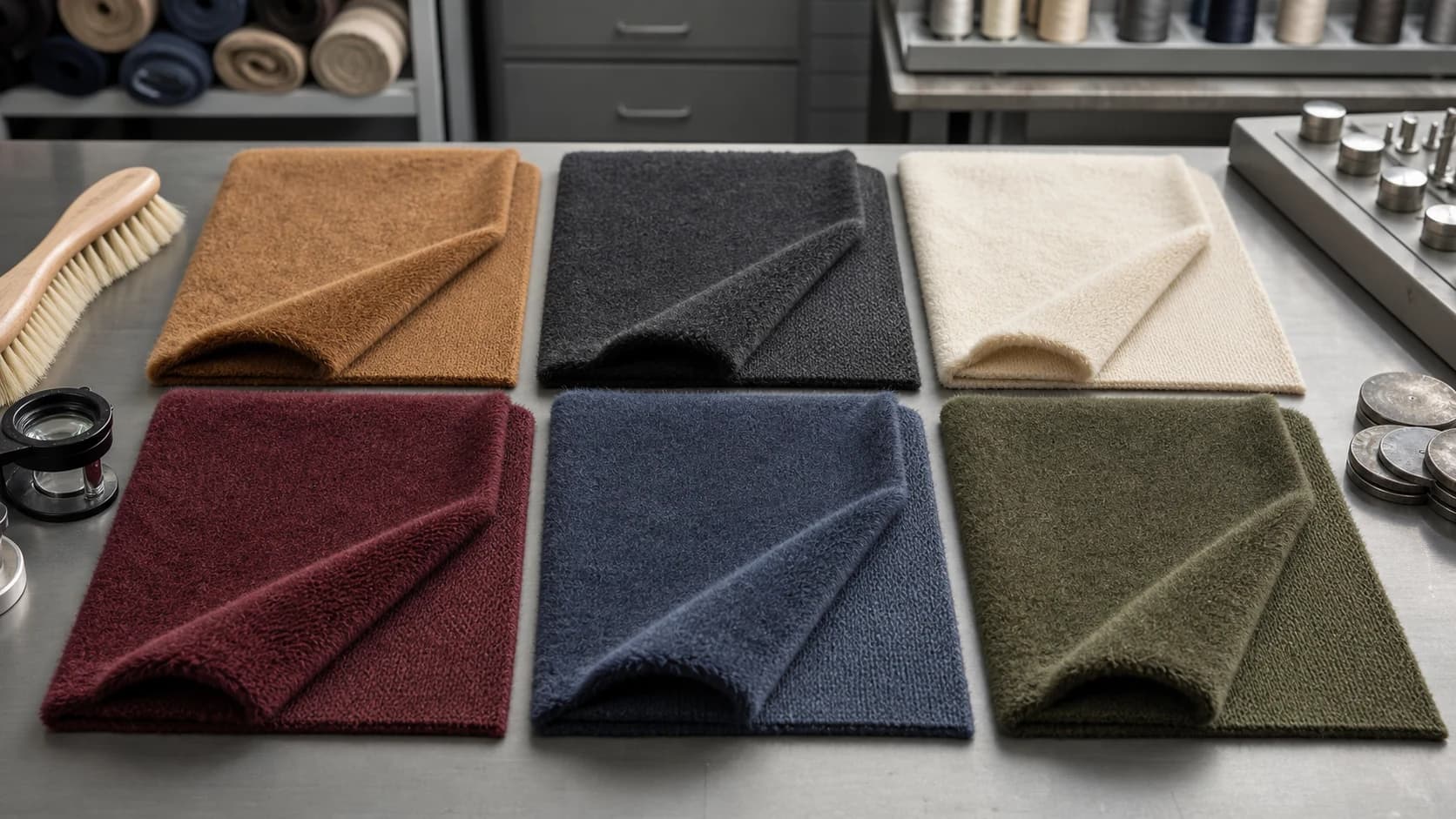
French terry fabric vs fleece is primarily a decision about the reverse surface and the garment result. French terry normally keeps visible loops on the back, while fleece usually adds a brushed or raised reverse for more bulk and insulation. Buyers should confirm the exact construction and finished sample instead of choosing from the category name alone.
Updated 2026-07-28 · Reviewed by O'range Textile sourcing team
Start with the reverse surface and intended garment
French terry commonly has a smooth outer face and visible yarn loops on the reverse. Fleece commonly starts from a sweatshirt-knit direction whose reverse is brushed, raised or otherwise finished to create a softer pile. The brushing operation changes bulk, warmth, shedding risk and the way the inside looks after laundering. It can also affect finished GSM and width, so the buyer should compare finished goods rather than unfinished references.
The garment brief decides which route is useful. A lighter loop-back construction can suit a trans-seasonal hoodie, training layer or casual pant that needs breathability and a clean interior. A raised fleece direction can suit a colder-season sweatshirt or warm loungewear programme. Lining, garment fit, rib trims, printing, embroidery and garment washing can change the final choice.
- State whether the reverse must show loops, a brushed pile or another finish.
- Name the garment, season, fit, target market and care route.
- Provide a face-and-reverse reference instead of the word soft alone.
- Explain whether printing, embroidery, garment washing or bonding is planned.
- Identify any requirement for recycled content, testing or supporting documents.
Compare performance fields before comparing price
GSM is useful for describing mass, but it does not independently prove warmth, quality or durability. Yarn type, loop length, density, brushing level, finish and trapped air all influence the hand and garment result. Ask for usable width after finishing because brushing, compacting and relaxation can change the cuttable width and consumption assumptions.
Stretch and recovery matter even when the garment is relaxed. Check whether the fabric grows at shoulders, knees or seat areas, whether the hem recovers, and whether the body twists or shrinks after care. For brushed fleece, inspect loose fibre, pilling and reverse appearance. For loop-back French terry, inspect loop regularity, snagging and the effect of seams or coverstitching.
| Buyer decision | French terry direction | Fleece direction |
|---|---|---|
| Reverse | Visible loops or low-profile loop back | Brushed, raised or fuller pile |
| Typical feel | Cleaner and often less bulky | Softer, fuller and more insulating |
| Priority checks | Loop regularity, snagging, shrinkage and drape | Pilling, shedding, bulk, shrinkage and care appearance |
| Garment route | Trans-seasonal hoodies, sweatshirts and casual bottoms | Cold-season hoodies, sweatshirts and warm loungewear |
Approve the same tests on the same sample state
Condition both samples before comparing weight, width and hand. Record the article, colour, finish, date and sample version. Measure GSM and usable width by the agreed method, then run the intended wash or care cycle. A comparison made between an unfinished loop-back sample and a fully brushed finished sample does not provide a reliable production decision.
Sew a garment-relevant panel or prototype. Review seam bulk, needle response, edge finishing, hood drape, pocket stability and rib compatibility. Repeat the visual and dimensional review after laundering. When a fabric is brushed, photograph the reverse under consistent light and note whether the pile changes direction, pills, mats or sheds.
- 01Confirm exact article identity, composition, face, reverse and finish.
- 02Condition the samples and measure GSM and usable width.
- 03Run stretch, recovery, shrinkage, pilling and colourfastness checks as required.
- 04Sew the critical garment seams and complete the intended care trial.
- 05Approve one dated sample and record every open production condition.
Write an RFQ that preserves the comparison decision
The RFQ should state whether the approved direction is loop-back French terry or brushed fleece and should identify the sample version. Add composition, target GSM, usable width, colour, face, reverse, finish, stretch, recovery, shrinkage, pilling, colourfastness, garment use, quantity, destination and documentation needs. Mark acceptable ranges and proposal fields clearly.
Ask the supplier to confirm the proposed article against the approved reference. Current sample terms, colour availability, quantity, MOQ, lead time, packing, payment, price and shipping basis belong in the current commercial response. Keeping these fields separate prevents an evergreen guide from becoming an unsupported stock or delivery promise.
Article evidence snapshot
Separate the construction decision from the commercial name
A supplier may use French terry, fleece, brushed terry or sweatshirt fleece for related constructions, but the names do not establish one universal specification. A useful comparison records the face, reverse, yarn system, GSM, usable width, stretch, recovery, shrinkage and finishing route for the exact sample. The buyer then tests the garment result and keeps availability, colour, MOQ, lead time and price in the current quotation.
- French terry decision
- Choose a visible loop-back direction when the programme needs a cleaner, less raised reverse, moderate insulation and a fabric that can serve trans-seasonal hoodies, sweatshirts or casual bottoms.
- Fleece decision
- Choose a brushed or raised reverse when the programme prioritises a fuller hand, trapped air and a warmer interior, then verify shedding, pilling and appearance after the intended care route.
- Approval evidence
- Use labelled face-and-reverse images, a finished cutting large enough for wash and seam trials, measured dimensional results and one dated approval record rather than a category label or unconditioned hand swatch.
Evidence boundary
This guide explains buyer decision criteria for French terry and fleece. Exact construction, composition, GSM, usable width, colour, finish, test results, live availability, sample terms, quantity, MOQ, lead time, price, packing and shipping require current confirmation for the specific article and inquiry.
Buyer questions
Frequently asked questions
Is French terry warmer than fleece?
Usually a brushed fleece direction feels warmer because the raised reverse traps more air, but warmth also depends on density, yarn, GSM, finishing, fit and garment construction. Compare the exact finished samples.
Can French terry be brushed?
Some suppliers use overlapping commercial names for brushed terry and fleece directions. Ask for the exact face, reverse and finishing description and approve the physical sample rather than relying on the label.
Which fabric is better for a trans-seasonal hoodie?
A loop-back French terry can provide a cleaner, less bulky reverse for trans-seasonal use. The final decision should consider climate, fit, GSM, layering, care and the tested garment prototype.
What should a buyer test on sweatshirt fleece?
Review pilling, shedding, shrinkage, colourfastness, surface appearance, seam bulk and garment performance after the intended care route. Record the exact article and finish used for approval.
Move from category research to a sample brief
Share the garment use, construction direction, composition, target GSM, usable width, color, finish and tests that matter. The team can then confirm the appropriate article and quotation route.